
 Search


Table of Contents
Thinking about setting up a company in Vietnam but not sure where to start? Don’t worry – we’ve got you covered! Our experienced team has helped thousands of foreign investors successfully establish their businesses in Vietnam.
To make the process seamless and stress-free, we’ve outlined four key steps to launching your business in Vietnam, including a comprehensive 12-step guide to fully setting up your company.
For a visual walkthrough, watch our video summary of the setup process below.
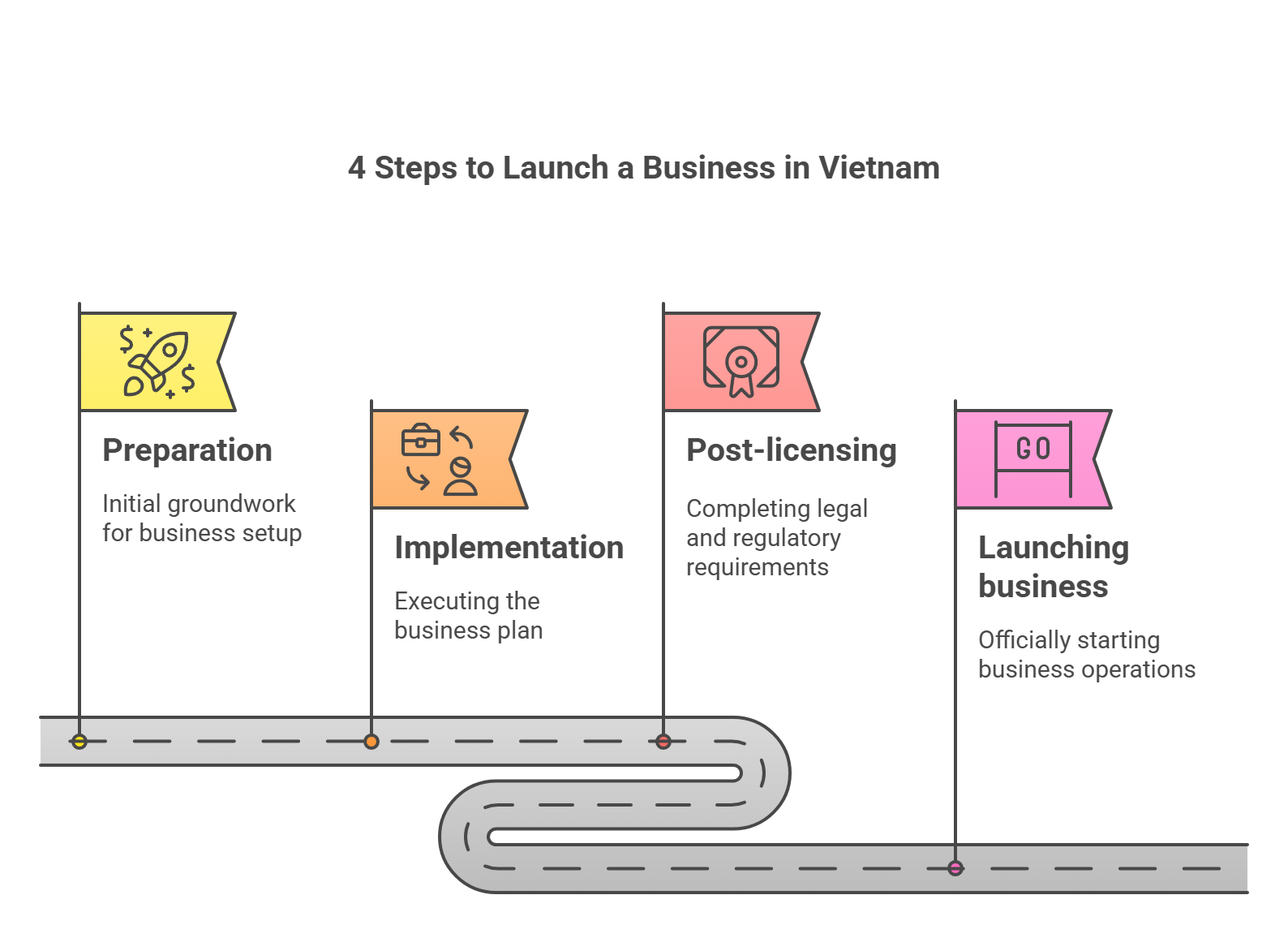
4 Stages of Setting Up a Company in Vietnam
Step 1: Conduct Market Research & Industry Insights
Before setting up a company in Vietnam, investors are strongly encouraged to conduct thorough market research to establish a clear path to success.
There are two key reasons why conducting market research is essential. First, from a business perspective, it helps investors determine whether Vietnam is a viable and promising market for investment. This involves analyzing consumer demand, evaluating the competition, and examining macroeconomic trends.
Second, from a legal standpoint, it provides insights into how open and accessible the market is for foreign investors. Investors must verify whether their business model is legally permitted under Vietnamese law. In other words, the legal framework serves as a prerequisite that determines how investors can operate in Vietnam.
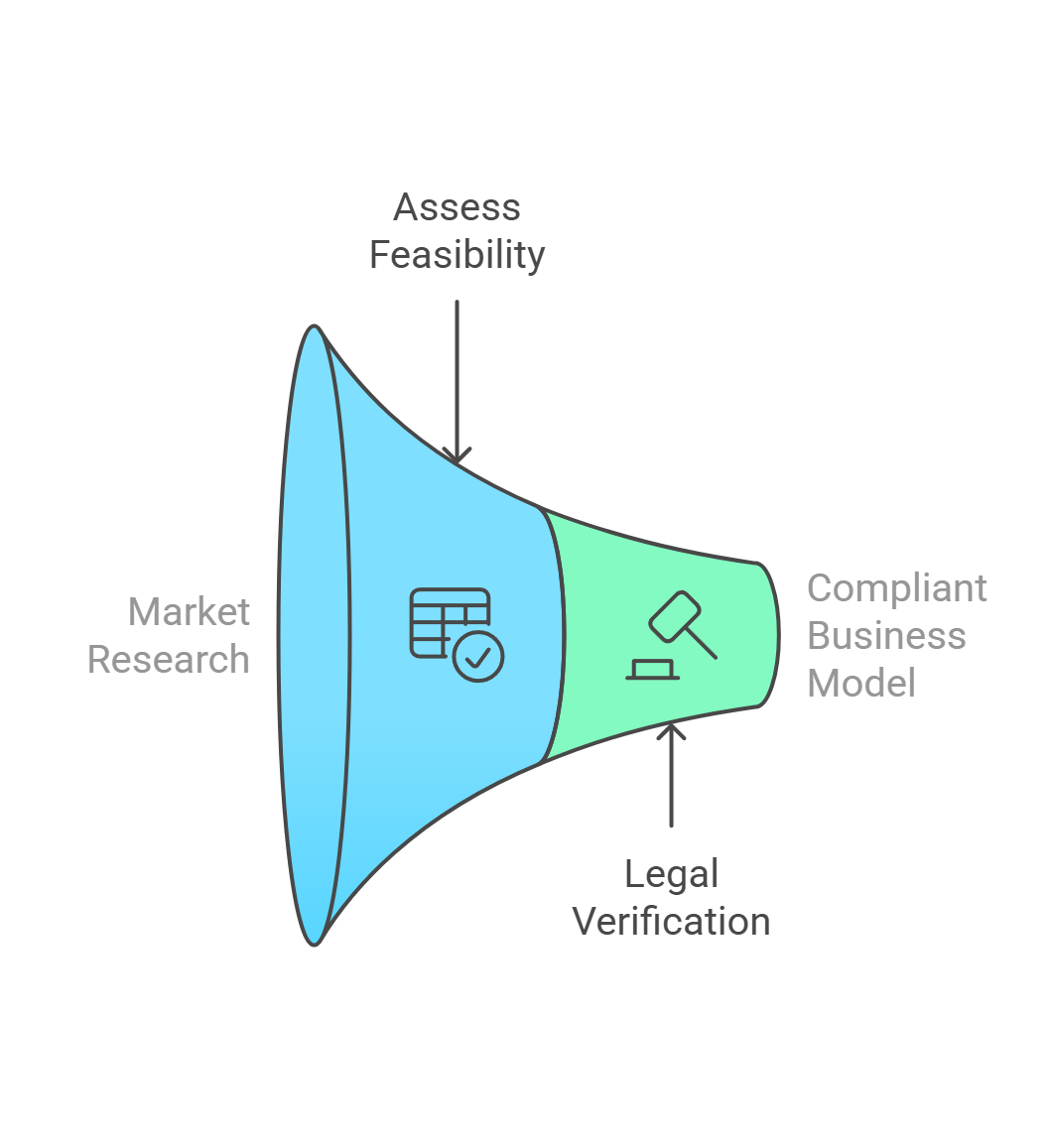
How Market Research Assists Investors in Setting Up a Company in Vietnam
From the perspective of Vietnam’s legal framework, setting up a company is subject to the following three sectors:
- Business sectors that are fully open to foreign investment.
- Business sectors that allow foreign investment but with specific conditions or restrictions.
- Business sectors that are entirely prohibited for foreign investors.
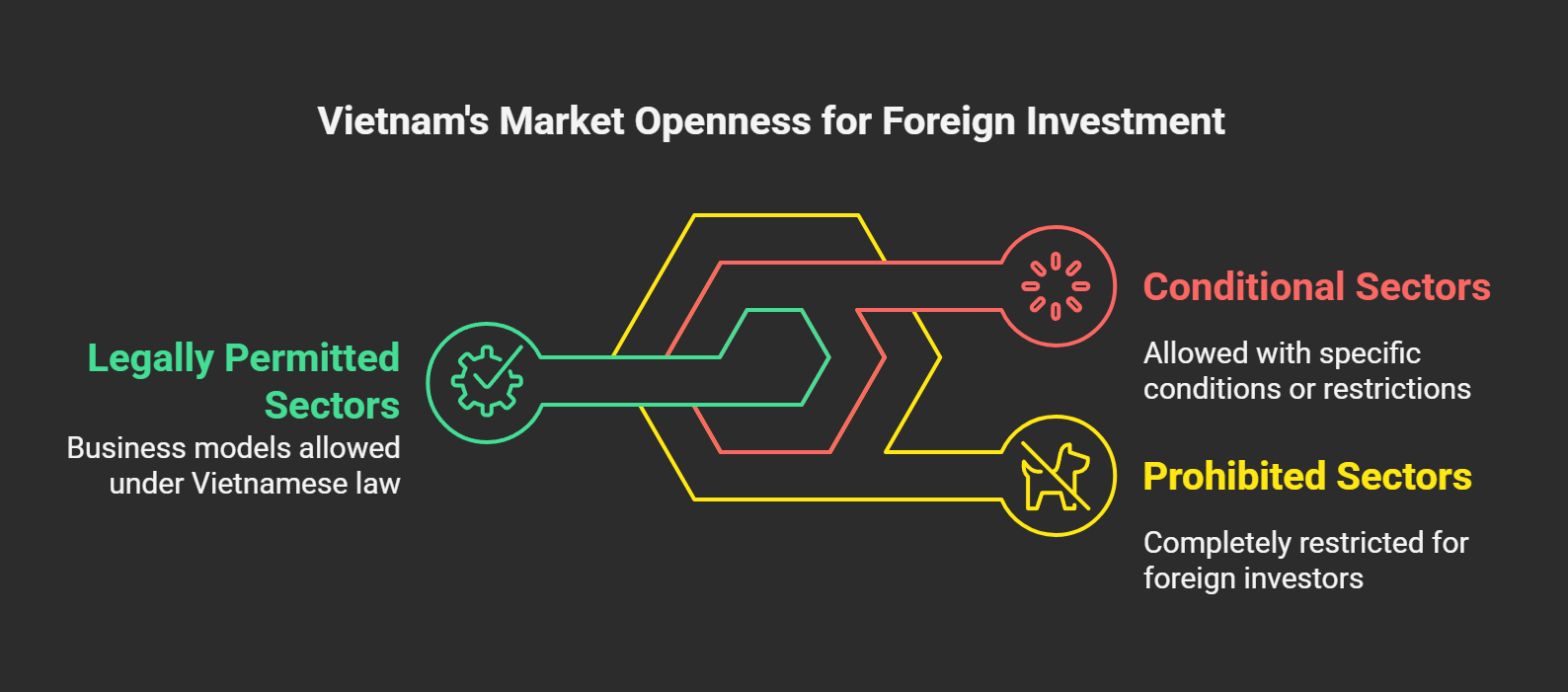
Legal Framework for Setting Up a Company in Vietnam
In short, conducting market research has a significant legal impact, as it directly influences how and to what extent a company can be set up in Vietnam. Key factors involved in setting up a company include capital requirements, ownership ratios, investment methods, necessary licenses, and the timeframe for completing the registration process.
>> Discover how open Vietnam’s market is to investors – click here for full details!
Step 2: Identify and Select Business Vehicle
Once you have completed the market analysis and determined that your business is a good fit, the next step is to identify common business structures and select the most suitable one for your needs.
In Vietnam, the three most common types of enterprises are single-member limited liability companies, multi-member limited liability companies, and joint-stock companies.
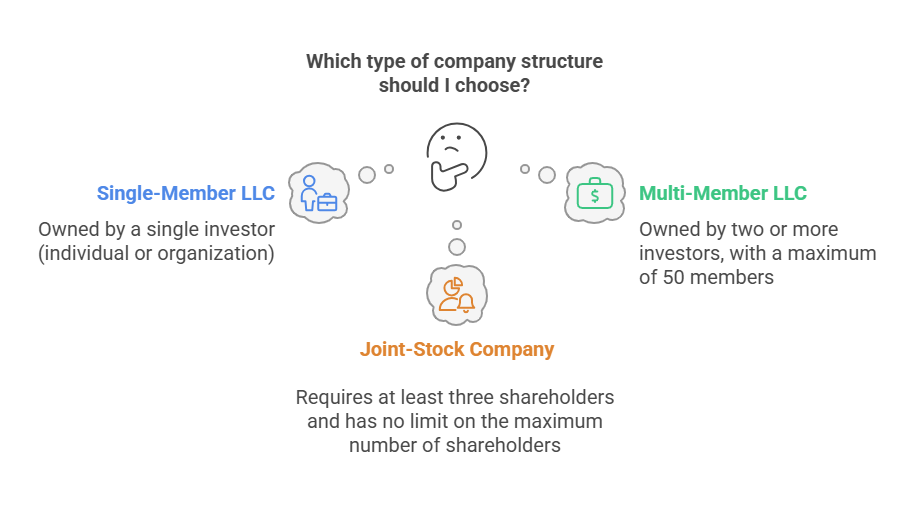
Common Business Vehicles for Setting Up a Company in Vietnam
Each type has distinct characteristics and requirements regarding capital, legal liability, and organizational structure. It is essential for investors to choose the most suitable business vehicle for setting up a company in Vietnam based on their business scale, industry, and development objectives.
>> Uncover the key details of each enterprise type here.
Step 3: Engage Experts
Engaging experts early is a smart and strategic decision when setting up a company in Vietnam.
Local expertise not only helps investors navigate regulatory requirements more effectively but also reduces risks, ensures legal compliance, and facilitates a smoother business launch.
Legal advisors, accounting and tax experts, and labor specialists are three key professionals investors should consider establishing long-term relationships with when setting up a company in Vietnam.
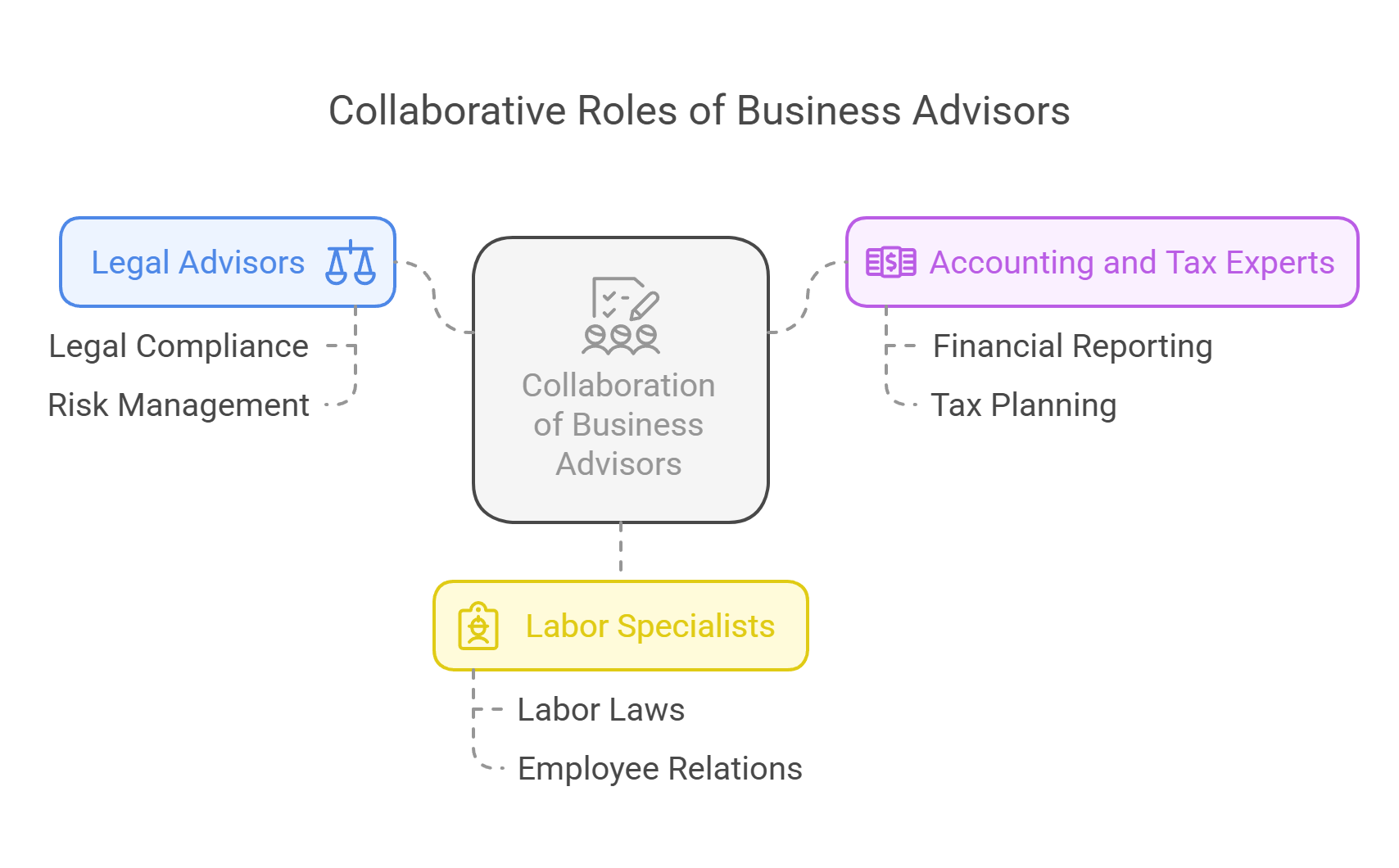
3 Key Advisors for Setting Up a Company in Vietnam
Apart from business incorporation, clients can rely on thele.blog as a one-stop service provider, offering all essential services in one place. Our corporate secretarial services are designed for investors who set up a company in Vietnam but do not reside permanently, ensuring their business operates smoothly and remains fully compliant with the law.
Step 4: Chose a Company Name
While investors often seek to set up a local business in Vietnam to expand their brand worldwide, their desired company name may not always be available.
To register a company name in Vietnam, two essential conditions must be met. The name should correspond to the chosen enterprise type and must be distinct, ensuring it is neither identical nor too similar to any existing registered name. Certainly, every company name must avoid prohibited or misleading terms.
Clients can verify the availability of their desired business name at https://dangkykinhdoanh.gov.vn/vn/Pages/Trangchu.aspx, or contact us today for a free name availability check. If necessary, we’ll recommend alternative options to ensure a smooth and efficient document preparation process.
Step 5: Get a lease
A key step in establishing a company is securing a lease for the headquarters address. This decision impacts both the registration process and eligibility for local investment incentives.
It is important to note that residential apartments cannot be used as a business headquarters. Choosing an incorrect location result in the rejection of your business registration application or cause delays in the process.
Common practice dictates that a lease agreement must initially be signed between the individual investor and the lessor. Once the company is established, an annex to the lease agreement must be signed, transferring the contracting party from the individual investor to the newly formed company.
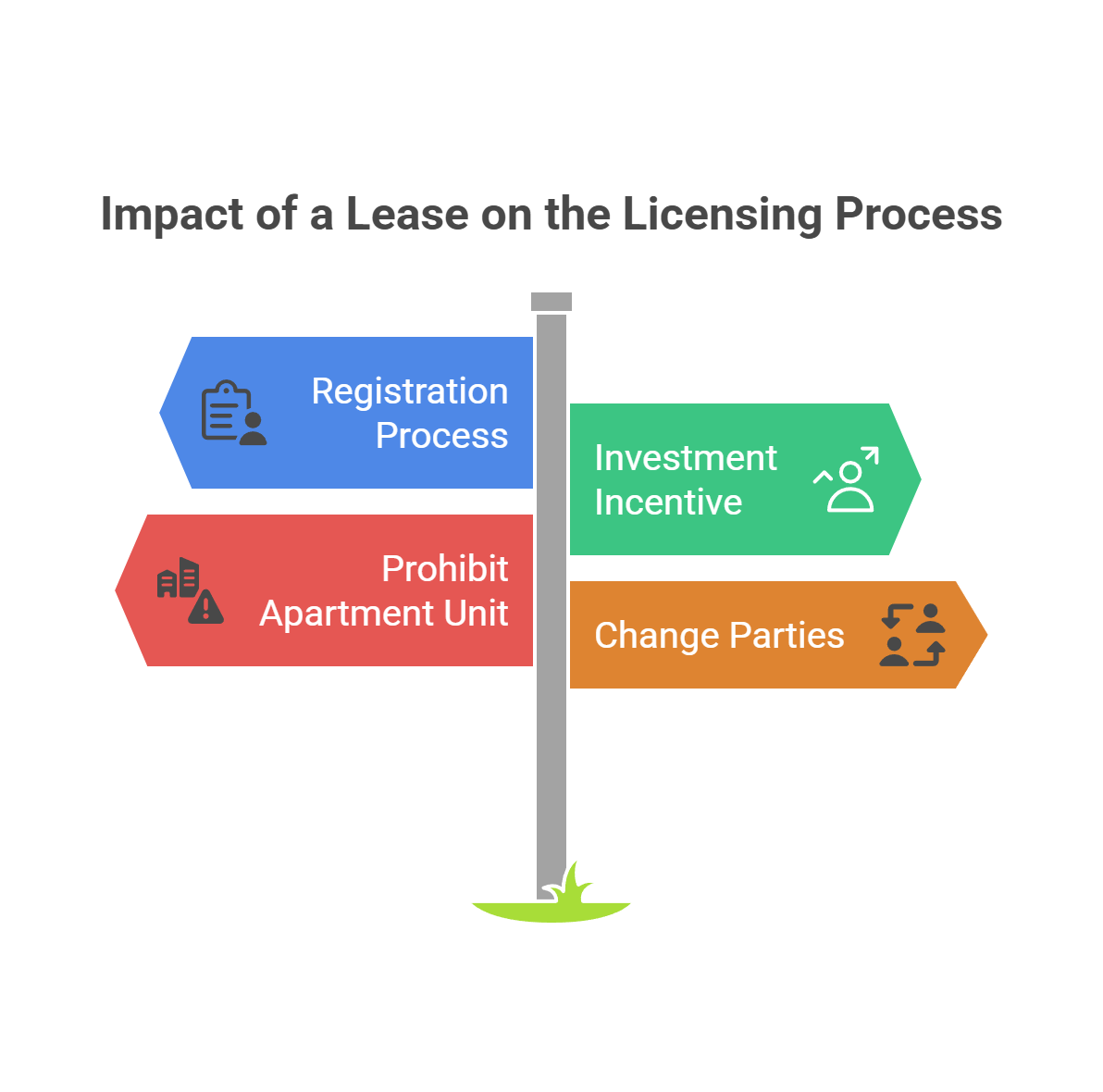
How Signing a Lease Affects Company Setup in Vietnam
Setting up a company with a virtual or shared office is a practical option for solo entrepreneurs or micro-investors who don’t need a physical workspace. To ensure a smooth and hassle-free experience for our clients, we partner with hundreds of shared office platforms across Vietnam, providing diverse options at competitive rates. Rest assured, thele.blog will handle this matter seamlessly for you.
Step 6: Prepare Required Documents
Document preparation is often the most challenging, tedious, and time-consuming part of setting up a company in Vietnam.
This is primarily due to two factors: every application must be in writing and wet-signed (physically signed with pen and ink). As a result, documents must be sent back and forth to comply with licensing authorities, especially if any errors or deficiencies arise.
More importantly, this step involves consular legalization, a process that most investors are unfamiliar with, making it challenging to handle independently. Therefore, avoid preparing the documents on your own. If you have any doubts or require specialized assistance with document preparation, feel free to consult thele.blog in advance.
>> Discover the five essential steps to have foreign documents consular legalized for use in Vietnam here.
Step 6.1: Documents Required for an Investment Registration Certificate
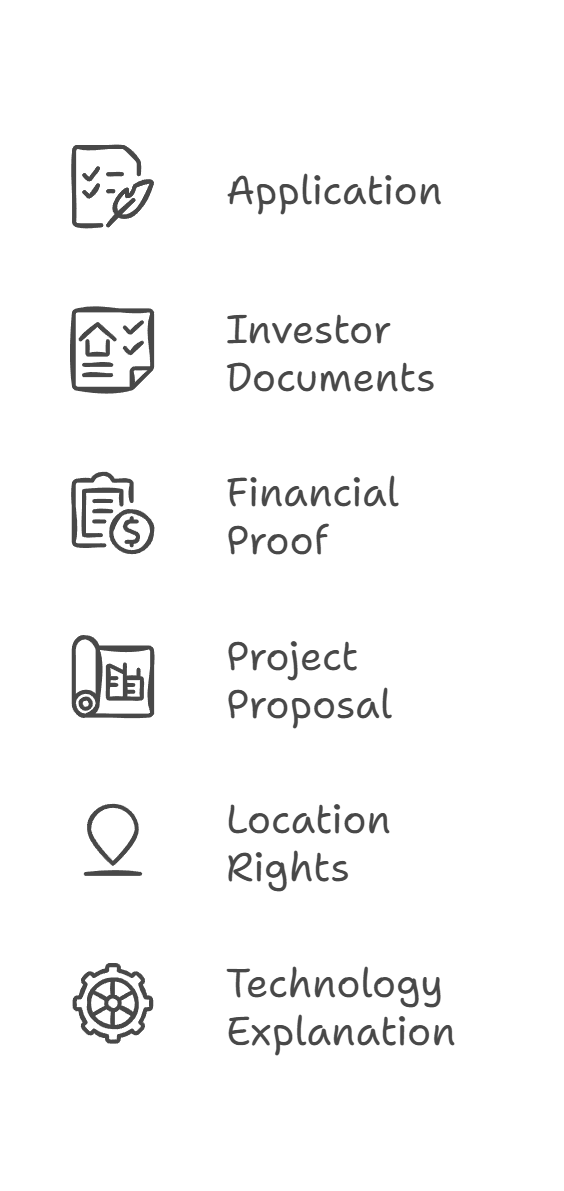
The following documents are listed for investors’ reference, outlining the typical requirements to obtain an Investment Registration Certificate in Vietnam:
- Investment Project Implementation application.
- Investor Identification Documents.
- Proof of the Investor’s Financial Capability.
- Investment Project Proposal.
- Proof of Business Location Rights.
- Technology Usage Explanation.
Special Notes: Additional documents may be required depending on the scale and industry of the investment.
Step 6.2: Documents Required for an Enterprise Registration Certificate
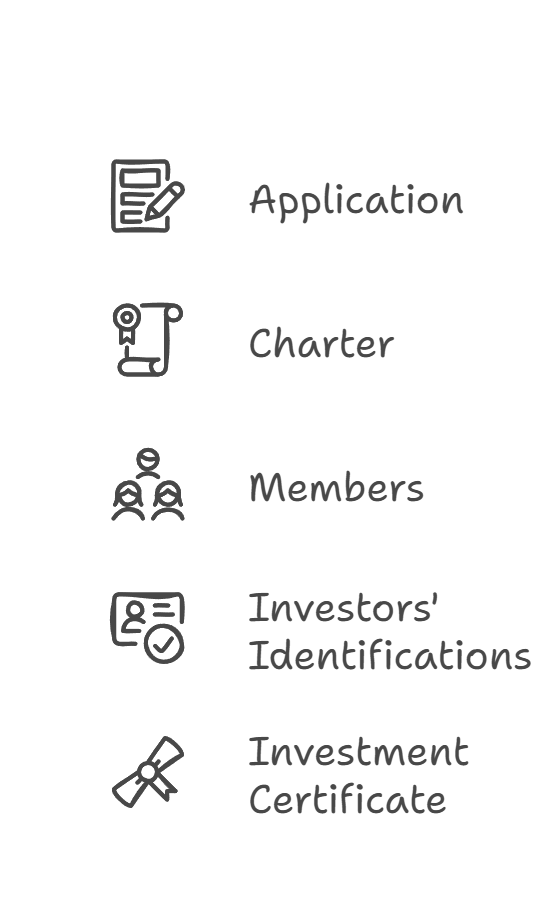
The following documents are required for to obtain an enterprise registration certificate:
- An Enterprise Registration application.
- Company charter.
- List of Members.
- Investor Identification Documents.
- Investment Registration Certificate.
Step 7: Apply for an Investment Registration Certificate
To successfully set up a company in Vietnam, investors must first obtain an Investment Registration Certificate. This certificate serves as the foundation for business expansion, as it signifies Vietnam’s official recognition and approval of the investor’s business proposal.
The application for an Investment Registration Certificate typically comprises the following three steps: Submit the application online, then physically submit the application, and finally, obtain the IRC.
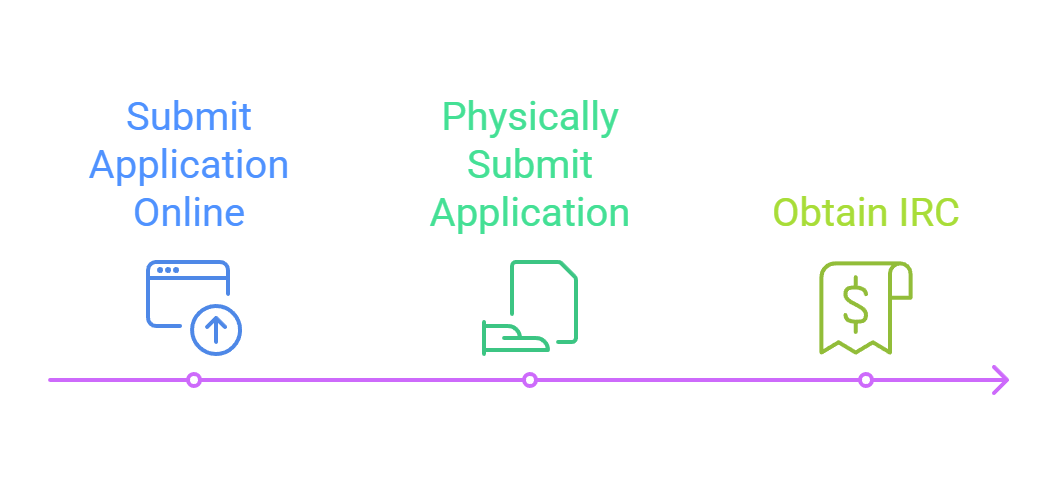
3 Steps to Obtain an IRC – A Key Milestone in Setting Up a Company in Vietnam
Step 7.1: Register the investment application online
Prior to making application for the Investment Registration Certificate (IRC), the investor must register project details online via the National Foreign Investment Information System.
Once the application is submitted, the investor will receive details to log on an account on the National Foreign Investment Information System to track the processing status.
The licensing authority will use the National Foreign Investment Information System to receive, process, and return the results of the application, provide application processing updates, as well as assign project codes.
Step 7.2: Physically submit the application
Within 15 days of submitting the application online, the investor must physically submit the Investment Registration Certificate application to the relevant licensing authority.
The appropriate authority depends on the company’s intended location in Vietnam:
- If the company headquarters are in an industrial zone, the application should be submitted to the Industrial Zone Management Board
- If the headquarters are outside an industrial zone, the application should be submitted to the Foreign Economic Relations Unit – Provincial Department of Planning and Investment
Step 7.3: Obtain the Investment Registration Certificate
Within 15 days of the receipt of the complete and valid application, the licensing authority issues the Investment Registration Certificate. If the application is rejected, the authority provides a written explanation outlining the reasons for rejection.
Step 8: Apply for an Enterprise Registration Certificate
Setting up a company in Vietnam is not considered complete until this step is completed.
Upon obtaining the Investment Registration Certificate, the investor must apply for the Enterprise Registration Certificate at the Department of Planning and Investment in the province where the company’s headquarters are located.
The licensing authority typically issues the Enterprise Registration Certificate within five business days after receiving a complete and valid application.
Step 9: Complete Post-Establishment Procedures
Congratulations!
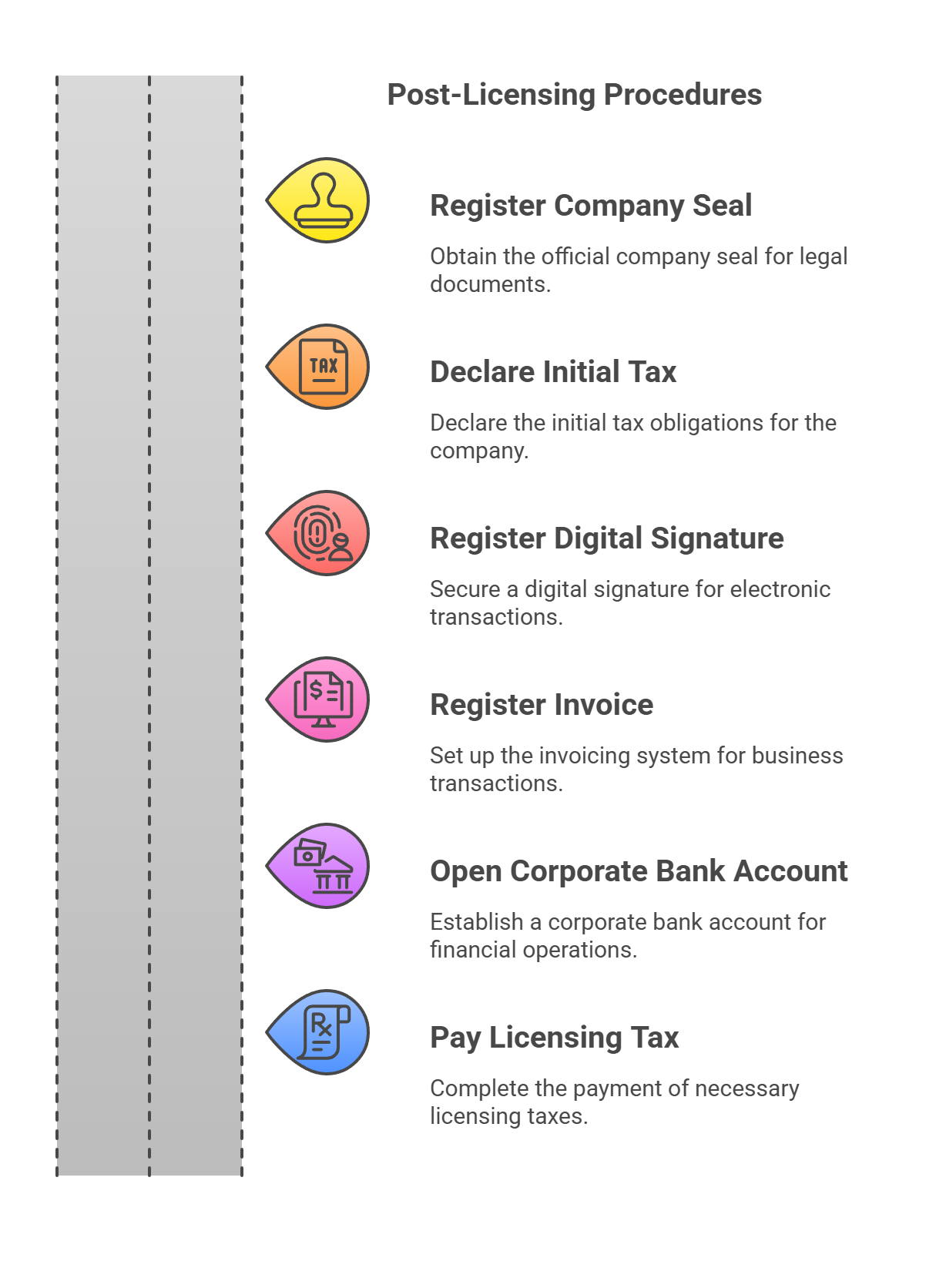
The entire process of setting up a company in Vietnam is now complete upon receiving the Enterprise Registration Certificate. However, to officially launch your business, investors must complete a series of post-licensing activities, including:
- Register the company seal
- Declare initial tax
- Register the company’s Digital Signature
- Register the Invoice
- Open a corporate bank account
- Pay licensing tax
The above activities should be completed as soon as possible, allowing investors to embark on their new journey with excitement, joy, and success.
Step 10: Inject Capital
Don’t forget to inject capital within 90 days of setting up the company (e.g upon receipt of the ERC).
The capital injection can be made in installments, provided it complies with this timeframe.
The capital injection should be transferred to the new company’s direct investment bank account and then to its transactional bank account. Failure or delay in injecting capital may require amendments to the Investment Registration Certificate and/or Enterprise Registration Certificate.
More importantly, failing to inject capital within the required timeframe or depositing it directly into the transactional bank account may prevent investors from remitting profits abroad when needed. Therefore, it is crucial to pay close attention to this issue
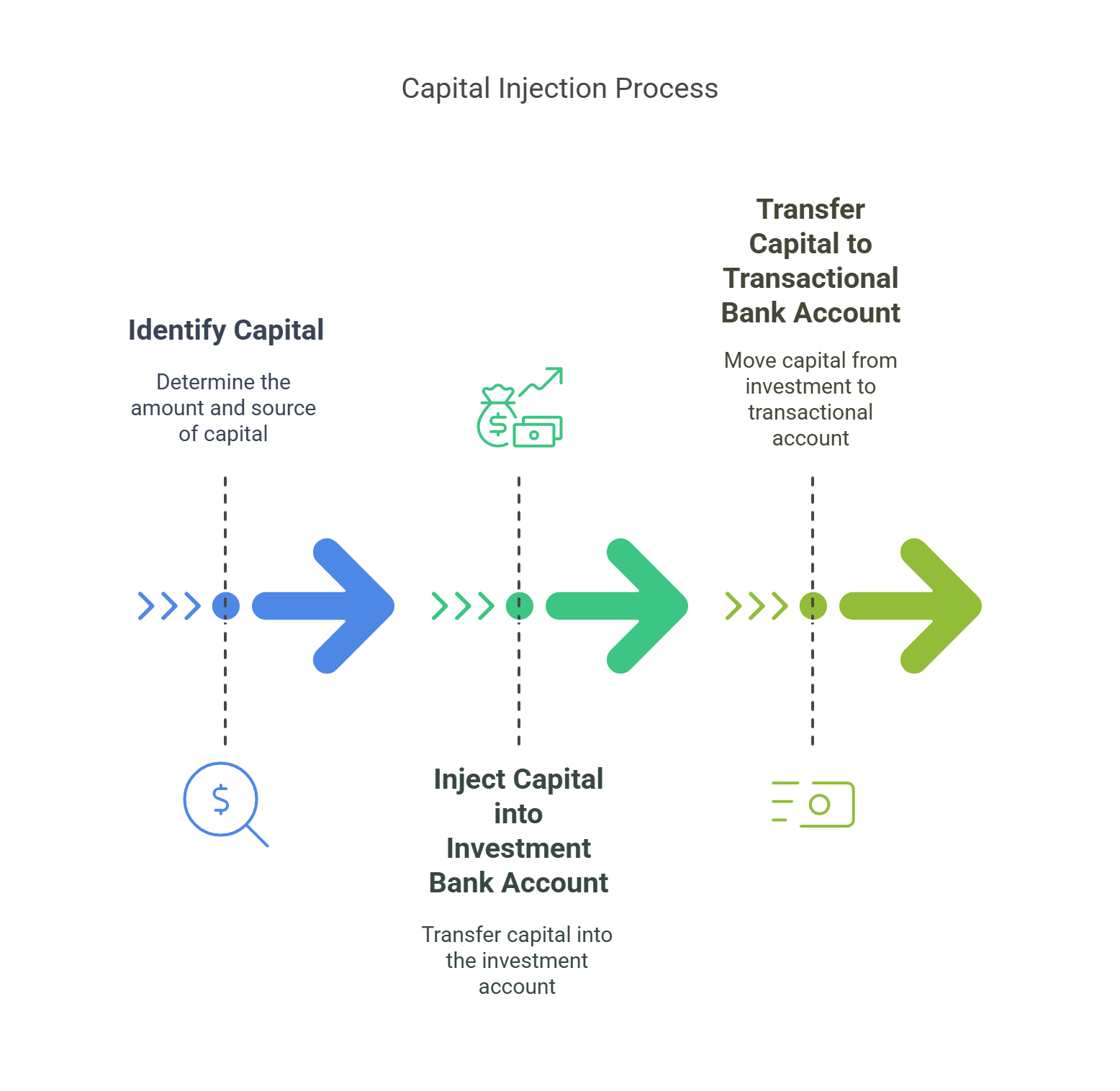
Capital Injection Process After Setting Up a Company in Vietnam
Step 11: Apply for Work Permit
As a common practice, our lawyers often advise investors to hire related members as employees when setting up a company in Vietnam. This strategy helps optimize setup and management costs while ensuring alignment with the investor’s policies.
Moreover, establishing a company in Vietnam and obtaining work permits for foreign employees will allow them to secure long-term visas in the country.
>>> Learn more about the procedures for obtaining a Work Permit in Vietnam in 2024 here
Step 12: Obtain Operational Permits or License
Once the company is established, the next step is obtaining the necessary operational permits or licenses.
Vietnamese law requires various operational permits and licenses depending on the industry in which the investor intends to operate. For example, food businesses must obtain food safety and hygiene certificates, while employment services require labor leasing licenses or employment service operation licenses.
Therefore, investors operating in conditional business sectors must have a thorough understanding of legal requirements to ensure compliance and avoid potential penalties.
Conclusion
Setting up a company and doing business in Vietnam can be challenging, but it is highly rewarding for those who embrace the journey.
Our goal with this 12-step guide to setting up a company in Vietnam is to provide investors with a clear and comprehensive overview of the key steps involved. If you need further assistance, thele.blog is always here to help. Don’t hesitate to reach out at (+84) 81235 3839, email us at thele.blog@thele.blog, or fill out the form below.

Leave A Comment